Most organisations treat UX as a cost centre.
Brief a designer.
Run some research.
Build a few prototypes.
Ship.
Six months later, when something breaks badly enough,
justify the spend again.
It's a slow, expensive cycle.
And it leaves enormous value on the table.
Autonomous UX is a different model entirely and it's worth being clear about what that means.
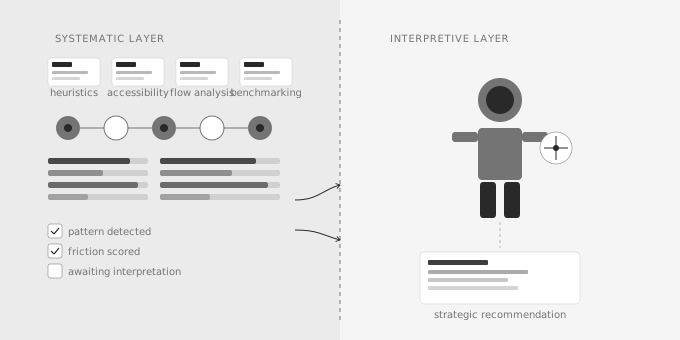
This isn't about removing designers from the process or letting systems make decisions on autopilot. It's about being precise about where human design expertise is genuinely irreplaceable, and where it's currently being wasted.
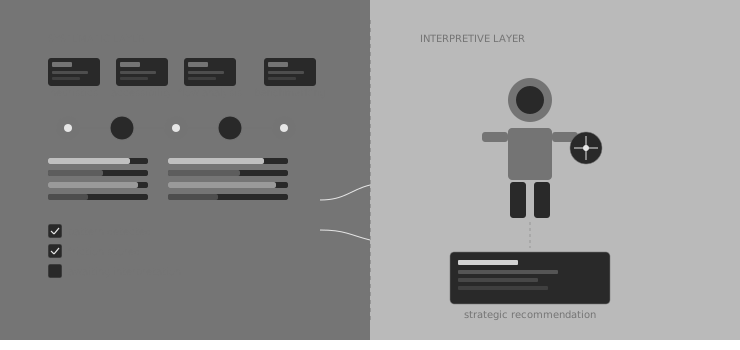
The systematic, pattern-based layers of UX work such as heuristic audits, accessibility analysis, interaction benchmarking, usability scoring; follow well-established frameworks. These are things AI-driven systems can execute faster and more consistently than manual processes, freeing your designers to focus on what actually requires human cognition: contextual interpretation, strategic synthesis, and the kind of nuanced judgement that connects a design decision to a real business outcome.
The result is a fundamentally different relationship between design effort and design impact. Faster feedback loops. More consistent quality. Human expertise applied where it matters most, not diluted across low-value, repeatable tasks.
This isn't a future-facing concept. The frameworks exist. The tooling exists. What most organisations are missing is a clear picture of how it maps onto their specific product, team, and context.
That's exactly what I want to walk you through.
